Troubleshooting · Nocatee 32081
Sub-Zero Frost Buildup & Defrost Failure in Nocatee
A freezer that's still cold while the fridge warms — and a coil wearing a blanket of ice — points at one system: the defrost circuit. Here's how to read it.
When a Sub-Zero in Nocatee ices over and the refrigerator warms while the freezer stays cold, the defrost system is the prime suspect: a failed defrost heater, defrost thermostat, or defrost control lets the evaporator coil frost solid, which strangles the airflow the fridge needs. That repair lands in the $550 to $1,100 lane. A manual defrost buys days, not a fix. Run the five checks below before you book.
For independent Sub-Zero repair across Nocatee and the 32081 master plan, call (904) 902-0927 for a same-week written quote or Book online.
Checked against current field notes · June 13, 2026
How a defrost failure ices a Sub-Zero over
Every frost-free Sub-Zero is supposed to melt the frost off its evaporator coil on a regular cycle. When that cycle stops happening, the coil turns into a block of ice — and the symptoms follow a predictable chain.
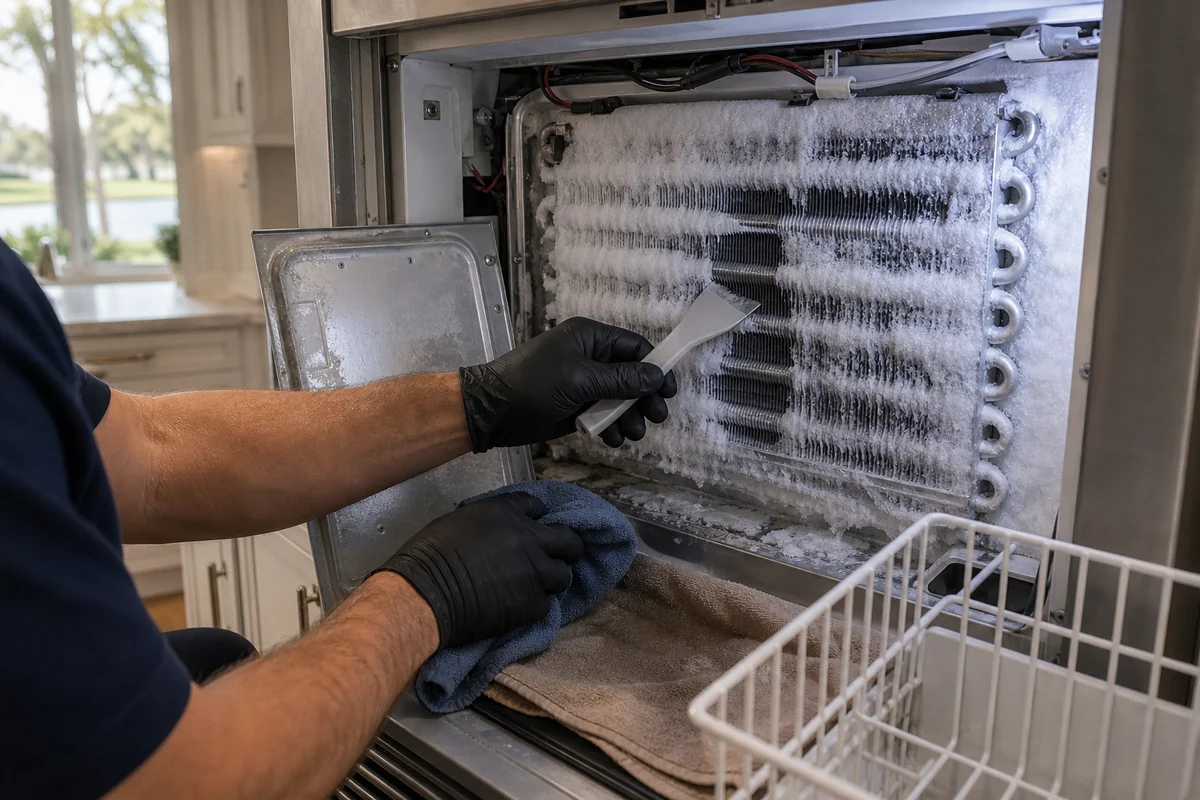
The cooling coil — the evaporator — naturally collects frost as it pulls heat out of the cabinet, because the moisture in the air freezes onto the cold metal. To stay clear, the unit periodically runs a small defrost heater that melts that frost away; a defrost thermostat (sometimes called a terminator) senses the coil temperature and tells the heater when to fire and when to stop, and a defrost control built into the main board schedules the whole cycle. If any one of those three fails, the heater never melts the frost, so each cooling cycle adds more ice until the coil is buried. A buried coil blocks the air the evaporator fan blows into the refrigerator, so the fridge warms while the freezer — sitting right against the coil — can still read near 0°F. That cold-freezer, warm-fridge split is the fingerprint of a defrost problem, and it's a common driver behind a warm-refrigerator complaint.
Defrost failure or just a door left open?
Not every patch of frost means a broken part. The cheapest cause to rule out first is humid air sneaking in — and in 32081 there's plenty of it.
| What you observe | Door-ajar frost | Defrost-system failure |
|---|---|---|
| Returns after a full defrost with doors shut | No — stays clear | Yes — rebuilds in days to weeks |
| Tied to a door, drawer, or alarm event | Usually yes | No — happens with doors sealed |
| Fridge warms while freezer holds near 0°F | Possible briefly | Yes — the classic pattern |
| Fix | Close/realign the door; let it clear | Replace the failed defrost component |
If the moisture is on the outside of the cabinet rather than icing the coil inside, you're looking at a seal issue instead — the condensation and sweating guide covers that.
Run these five checks before you call anyone
Twenty minutes here sorts a self-clearing frost-in from a failed component, and hands dispatch the temperatures and frost pattern that point at the right part.
- Confirm no door has been left ajar. Before suspecting the defrost system, rule out the simple cause: a drawer or door held open, an over-stuffed shelf blocking it from latching, or a door-ajar alarm you tuned out. A door left cracked in humid 32081 air can frost an evaporator on its own — and that frost clears once the door seals properly.
- Read both compartment temperatures. Sub-Zero targets 38°F in the refrigerator and 0°F in the freezer. A classic defrost failure reads as a freezer that still holds near 0°F while the refrigerator drifts warm, because the iced evaporator chokes the airflow that the fridge side depends on. Note both numbers before you call.
- Look at the evaporator panel for ice. If you can see the back interior panel where the cooling coil lives, a thick white blanket of frost over it — not the light dusting normal on a freezer wall — is the visible signature of a defrost system that has stopped clearing itself.
- Listen and feel for airflow. With the door open, you should sense air moving from the vents and hear the evaporator fan. A coil packed in ice blocks that air; the fan may also be stalled against the frost. Weak or absent airflow with a cold freezer is the tell that ice, not the sealed system, is the problem.
- Resist the urge to call a manual defrost a fix. Powering the unit down for a day melts the ice and the fridge cools again — for a while. But if a heater, thermostat, or control failed, the frost rebuilds within days to weeks. A manual defrost is a useful diagnostic clue and a food-saving stopgap, not a repair.
Match the symptom to the likely cause and cost
These are the frost-and-defrost patterns from our 32081 call sheet, with the planning lane each one usually lands in. Final numbers always come as a written quote before any part goes in.
| What you're seeing | First thing we check | Planning lane |
|---|---|---|
| Freezer near 0°F, fridge warm, coil iced solid | Defrost thermostat, then heater, then control | $550–$1,100 |
| Frost clears on manual defrost, rebuilds in a week | Which defrost component failed (electrical test) | $550–$1,100 |
| Frost only after a door was left ajar | Door seal and alignment, then re-observe | $250–$450 if seal/alignment only |
| EC 50 / EC 40 code alongside the frost | Excessive run time from the iced coil | $550–$1,100; see EC 50 explainer |
| Frost plus only a partial 4–8" frost stripe on the coil | Possible sealed-system leak, not defrost | $1,500–$3,000 (sealed system) |
A defrost code reference for Sub-Zero owners
Sub-Zero doesn't print a dedicated "defrost" number on the display. What it shows are run-time and service indicators that a defrost-iced coil can set off. Here are the real, documented ones — no invented codes.
| Indicator | What it means | Tie to defrost |
|---|---|---|
| EC 50 | Excessive compressor run time, refrigerator side | An iced coil forces long runs as the fridge can't reach temperature |
| EC 40 | Excessive compressor run time, freezer side | Same mechanism on the freezer-side system |
| Service light | The unit is flagging it wants a technician | Can accompany the sensor and run-time faults a frosted coil produces |
| "Vacuum Condenser" light | 600-series boards, 1998–2002: excessive run warning | Run-time warning; rule out a dirty condenser and an iced coil together |
If a code is on your display, our EC 50 explainer walks through what it is and isn't before you assume the worst.
Why defrost calls cluster on Nocatee's older built-ins
Two local factors push frost calls our way. First is the humidity: coastal Northeast Florida runs a high dew point for much of the year, so every time a door opens, more moisture rides into the cabinet and ends up on the coil. A healthy defrost cycle handles that easily — but it means a unit here works its defrost system harder than the same model would in a dry climate, so a marginal heater or thermostat reveals itself sooner.
Second is the age of the housing stock. Coastal Oaks brought Nocatee's first residents in 2006, and those early built-ins are now at the age where defrost heaters and thermostats wear out and 600-series and BI-series control boards start to fail. Some scarce 600-series boards are rebuilt rather than replaced. Newer Twenty Mile and Anthem Ridge units are reaching the same window. A defrost fault often shows up first as a warm fridge, which is why our freezer repair and not-cooling diagnostics overlap so often with this one — and why we test the defrost circuit before ever talking about the sealed system.
An educational diagnostic scenario from Anthem Ridge
Educational diagnostic scenario — a composite teaching example, not a customer review. A 2012 BI-36UFD in an Anthem Ridge kitchen reads 49°F up top while the freezer holds a solid 1°F. The owner had already powered it off overnight twice, each time getting a day or two of normal cooling before it warmed again. Pulling the rear evaporator panel showed the coil packed in ice. Electrical testing isolated an open defrost thermostat that never let the heater run. One component, one visit, moderate lane — and the on-off cycling the owner had been doing was the clue that pointed straight at defrost. The lesson: if a manual defrost keeps "fixing" it for only a few days, you have a defrost-circuit failure, not a one-time frost-in.
A second scenario, from Coastal Oaks
Educational diagnostic scenario — a composite teaching example, not a customer review. A Coastal Oaks unit showed heavy frost — but only a narrow 4-to-6-inch stripe of frost on the evaporator, with the rest of the coil bare. That partial pattern is not a defrost story at all; it's the classic signature of a sealed-system refrigerant leak, which lands in the $1,500–$3,000 sealed-system lane. The lesson: full-coil frost points at defrost; a short partial frost stripe points at the sealed system, and reading that pattern correctly is what keeps an owner from buying the wrong repair.
What a defrost visit costs in 32081
Sub-Zero Service Nocatee diagnoses and repairs frost-and-defrost faults across Nocatee 32081 — call (904) 902-0927 or use the online reservation page, and a tech arrives ready to read both compartment temperatures, inspect the evaporator, and electrically test the defrost circuit before recommending a part. The visit produces a written finding and a firm quote before repair work starts.
A defrost thermostat, heater, or control repair sits in the $550 to $1,100 lane, with the thermostat at the lower end and boards higher. If the door seal turns out to be the real source of the frost, an alignment or gasket fix is closer to $250 to $1,100; if the frost pattern reveals a sealed-system leak instead, that's the $1,500 to $3,000 lane and we don't quote it without pressure evidence first. Whatever the cause, skip the endless manual-defrost cycle — it strains the food and the compressor without curing anything. If a code is showing, read what an EC 50 readout means first, and if your unit may still be covered, our guide to factory warranty versus independent repair will route you to the right door.
Frost and defrost questions, answered straight
Why does my Sub-Zero freezer stay cold but the refrigerator gets warm?
That split is the textbook signature of a defrost failure. The refrigerator side is cooled by air blown across the evaporator coil; when the defrost system stops clearing the coil, it ices over and blocks that airflow. The freezer, sitting right at the coil, may still feel near 0°F while the fridge starves for cold air and drifts up. It looks like the fridge is dying, but the real fault is the defrost circuit choking the airflow.
What actually fails in a Sub-Zero defrost system?
Three parts, in rough order of how often we find them: the defrost heater that periodically melts coil frost, the defrost thermostat (or terminator) that tells the heater when to run and when to stop, and the defrost control or main board that schedules the cycle. Any one failing leaves the coil to ice over between cooling cycles until airflow collapses. A technician isolates which one with electrical tests rather than swapping parts blindly.
How is defrost frost different from frost from a door left open?
A door left ajar dumps humid Nocatee air into the cabinet, and that moisture freezes onto the coil and walls — but once the door seals, the system clears it on its normal cycle and stays clear. Defrost-failure frost comes back even with the doors shut tight, and it keeps thickening over days. The test is simple: fix the door, fully defrost the unit, and watch. If heavy frost returns within a week or two with doors closed, the defrost system is the culprit.
How much does a Sub-Zero defrost repair cost?
A defrost heater, thermostat, or control repair sits in our thermistor, gasket, or control-board lane, roughly $550 to $1,100, depending on which component failed and the model. A defrost thermostat is usually the lower end; a control board on a 600-series or BI unit runs higher, and scarce 600-series boards are sometimes rebuilt rather than replaced. You get a written quote after the in-person electrical diagnosis.
Why is manually defrosting my Sub-Zero only a temporary fix?
Melting the ice restores airflow and the fridge cools again, which is why it feels like a fix. But the underlying component — heater, thermostat, or control — is still failed, so the coil simply ices over again on the next cycles. Within days to a couple of weeks the same warm-fridge, cold-freezer pattern returns. A manual defrost is a smart way to save food and confirm the diagnosis, not a substitute for replacing the failed part.
Can a defrost problem trigger an EC 50 code on my Sub-Zero?
It can contribute. EC 50 means the refrigerator-side compressor has been running far too long, and an iced evaporator forces exactly that — the system runs and runs trying to cool a fridge it can no longer move air into. EC 40 is the same idea on the freezer side. The codes flag excessive run time; a frosted coil from a defrost failure is one of the reasons that run time climbs. Our EC 50 explainer covers the code itself in detail.
Ready when your Sub-Zero isn't
Weekdays 8 to 7, Saturdays 9 to 3. Gate access handled, floors protected.