Repair · Nocatee & Ponte Vedra 32081
Sub-Zero Sealed System & Compressor Repair in Nocatee
The most expensive repair a Sub-Zero needs — and the one where a diagnosis-first shop saves you the most money.
A Sub-Zero sealed system covers the compressor, condenser, evaporator, and refrigerant charge — the parts that actually make cold. When one fails, repair in Nocatee runs roughly $1,500–$3,000 by EPA-certified techs, always quoted in writing after pressure evidence and well under the $8,000–$15,000 cost of replacing a built-in. We rule out cheaper look-alike causes first, and units still under factory sealed-system coverage get routed to the factory instead.
For independent Sub-Zero repair across Nocatee and the 32081 master plan, call (904) 902-0927 for a same-week written quote or Book online.
Page reviewed against our service log: June 13, 2026.
What “sealed system” actually means
The sealed system is the closed refrigerant loop at the heart of every Sub-Zero®: the compressor pumps refrigerant, the condenser coil sheds the heat, the evaporator pulls cold into the cabinet, and a filter-drier keeps the loop clean. It is welded shut at the factory, which is exactly why it is the one repair an owner can never touch and the one that demands certification, recovery equipment, and a measured recharge.
On Nocatee's older Coastal Oaks units — the 600-series and first-run BI cabinets now fifteen-plus years old — sealed-system failures show up as a slow warm-up over days, partial frost on the evaporator, or a compressor that runs and runs without pulling the cabinet down. Each of those also has a cheaper impostor, which is why we never quote sealed-system money before the not-cooling walkthrough and an airflow check have cleared the inexpensive causes.
If your unit is showing a code or a hot compressor after a long, hot afternoon, read what an EC 50 code is telling you first — excessive run time is frequently a $250–$550 cleaning, not a five-figure conversation.
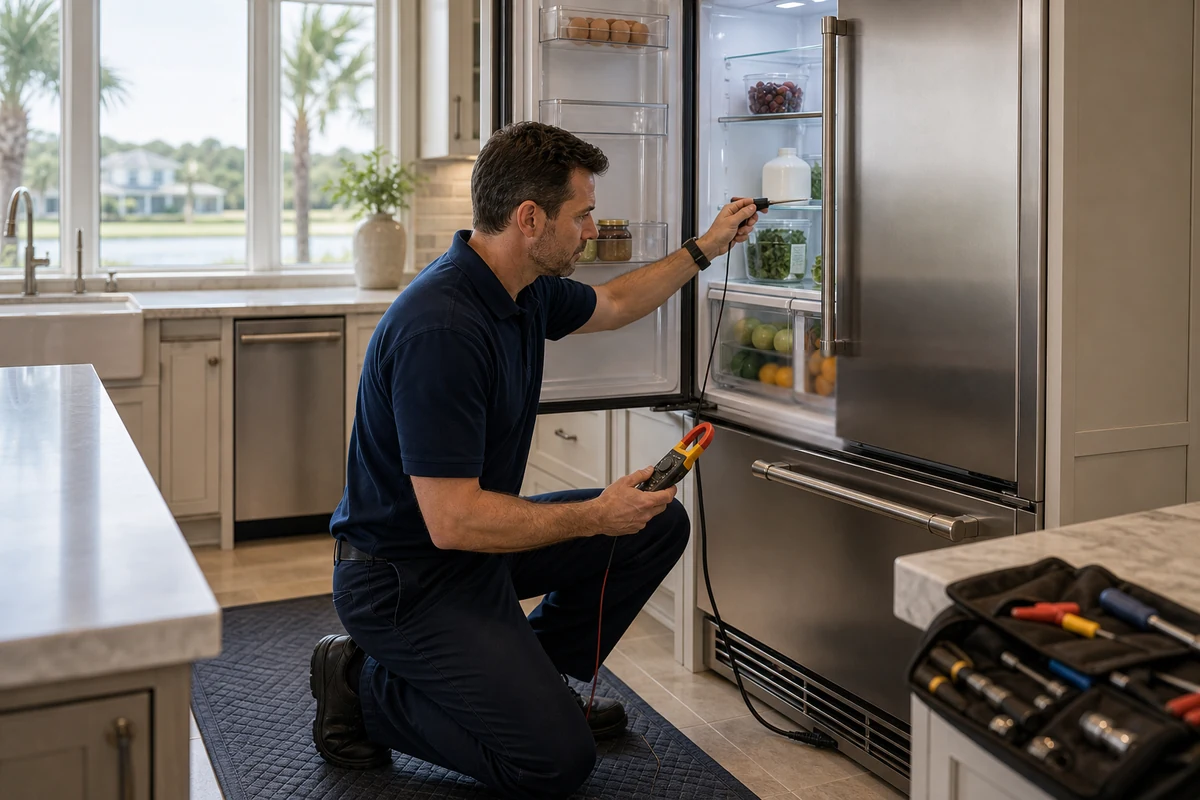
The sealed-system components, and what each repair costs
These are the sealed-system jobs we see in 32081, with the evidence that points to each and the cost lane it lands in. Every one is quoted in writing after diagnosis.
| Component / fault | How we confirm it | Typical lane |
|---|---|---|
| Refrigerant leak (line, joint, or coil) | Pressure drop plus electronic leak detection | $1,500–$2,500 |
| Compressor replacement | Amp draw, start behavior, and no pull-down on good airflow | $1,000–$2,000+ |
| Evaporator replacement | Partial frost pattern and pressures inconsistent with charge | $1,500–$3,000 |
| Condenser / filter-drier with recharge | Restriction evidence; drier saturated after a prior opening | $1,200–$2,200 |
Note the floor: nothing here is a small number, which is precisely why the cheap impostors get ruled out first. A condenser coil cleaning at $250–$550 closes the most common look-alike before a gauge is ever connected.
Repair or replace? The Nocatee math
This is the real decision behind a sealed-system quote, and it is usually less close than owners fear. A built-in Sub-Zero is engineered for a twenty-year service life, and the cabinet, the flush installation, and the custom panels are the parts that make replacement so expensive — not the sealed system inside. Replacing a BI over-under or a panel-ready Designer column new, with cabinetry and panel refit, commonly runs $8,000–$15,000 in a Twenty Mile or Coastal Oaks custom kitchen.
Against that, a $1,500–$3,000 sealed-system repair on a structurally sound 10–18-year-old unit is the cheaper, lower-disruption choice in the large majority of cases. The exceptions are honest ones: a cabinet with multiple simultaneous failures, corrosion through the evaporator, or a discontinued part with no rebuild path. When replacement genuinely is the smarter spend, we say so plainly — and our warranty guide covers whether the factory should be paying for any of it first.
An educational scenario from Coastal Oaks
A composite case we use for owner education, not a customer review: a 2008 BI-36UFD in Coastal Oaks warms slowly over a week, with frost on only the lower third of the evaporator. Airflow is clean, the fan runs, the board responds — so the cheap causes are out. Gauge pressures confirm a low charge from a slow evaporator leak. The evaporator and filter-drier are replaced, the system is evacuated and recharged to the factory weight, and a sixteen-year-old cabinet holds 38°F / 0°F again for a fraction of replacement cost.
How a sealed-system repair is done right
- Cheap causes cleared first. Airflow, condenser, fan, gasket, and board checks before any gauge touches a port — no sealed-system quote on a dirty coil.
- Pressure evidence. Manifold gauges on the service ports, readings compared against the charge spec for your model, plus leak detection when pressures drop.
- Recovery, not venting. Refrigerant is recovered into proper equipment — EPA-required and the only legal way — never vented to atmosphere.
- Repair with a new filter-drier. Brazing with a heat shield away from cabinetry, a fresh filter-drier every time the loop is opened, then a deep vacuum to pull moisture.
- Measured recharge and verify. Charged to the factory weight, then run to confirm pull-down and stable 38°F / 0°F before we leave.
One scheduling note for gated streets: we keep gate procedures for Coastal Oaks, Twenty Mile, and the gated villages on file, so a two-visit job doesn't lose an appointment window to attended-entry approvals. Call (904) 902-0927 or use the online booking page to start with a diagnosis.
Telling a sealed-system fault from its cheaper twins
Three failures feel identical from the kitchen but cost very different money. Here is how the evidence diverges once you know what to watch — and why we always test for the cheap cause first.
| The pair | Points to the cheaper cause | Points to the sealed system |
|---|---|---|
| Refrigerant leak vs. evaporator fan | Warms in hours, cabinet silent, no air moving ($250–$550) | Warms over days, partial frost on the evaporator |
| Failing compressor vs. dirty condenser | Matted grille; cools after a clean and 24 hours ($250–$550) | Clean coil, compressor hot, still no pull-down |
| Low charge vs. brownout-locked board | Lights on, panel blank, follows a storm outage ($550–$1,100) | Panel responds, pressures read low against spec |
The single most useful clue is the freezer side: when it still freezes hard, the sealed system is almost always intact, which rules out the most expensive causes before a truck rolls. That is why the refrigerator repair walkthrough and the five-check not-cooling guide are the right first stop for most warm units.
Sealed-system questions from 32081 owners
Is a sealed-system repair on a Sub-Zero ever worth it versus replacing the unit?
Often, yes — and that math is the whole reason this page exists. A built-in Sub-Zero column or BI over-under replaced new runs $8,000–$15,000-plus once cabinetry and panels are refit, so a $1,500–$3,000 sealed-system repair on a sound 10–18-year-old cabinet is usually the cheaper decision by a wide margin. We give you the honest replace-versus-repair number before you commit, not after.
How do you know it is the sealed system and not something cheaper?
We rule out the cheap causes first, on purpose. A dust-matted condenser, a dead evaporator fan, and a tired gasket all mimic a refrigerant problem, so airflow, electrical, and frost-pattern checks come before any gauge touches a port. Only when those clear and the pressures confirm it do we name sealed-system money. Partial frost on the evaporator plus a slow warm-up over days is the classic signature.
Are you certified to handle refrigerant on a Sub-Zero?
Yes — sealed-system work requires EPA Section 608 certification to recover, evacuate, and recharge refrigerant legally, and we are certified for it. On Sub-Zero equipment that also means matching the exact refrigerant type and charge weight to your model; an eyeballed charge is how a $2,000 repair turns into a second failure.
My Sub-Zero is twelve years old — could the sealed system still be under factory coverage?
Possibly, and it is worth thirty seconds to check before you accept any quote. Sub-Zero's sealed-system coverage on the compressor, condenser, and evaporator runs years longer than its full parts-and-labor term, so a unit that is past everyday coverage can still have the major sealed component covered. Read the serial to the factory first. Our warranty guide walks through exactly where that line sits.
How many visits does a compressor or evaporator job take in Nocatee?
Plan on one to two. Diagnosis and the written quote happen on the first visit; the repair itself is scheduled once the correct compressor or evaporator and a fresh filter-drier are confirmed for your serial. Refrigerant recovery, brazing with a heat shield away from cabinetry, evacuation, and a measured recharge are not rushed — doing them properly is what makes the repair last.
Does Nocatee humidity or storm season affect sealed-system failures?
Indirectly but really. Years of running a compressor hard against a dust-choked condenser in a humid, garage-adjacent kitchen wears the sealed system early, and a single restoration surge after a storm outage can finish a marginal compressor. Most sealed-system failures we see in 32081 trace back to a cooling system that was overworked long before it quit — which is why annual coil cleaning is the cheapest insurance against this whole cost lane.
What is a filter-drier and why do you always replace it?
It is a small canister in the refrigerant loop that traps moisture and debris. Any time a sealed system is opened — for a compressor, evaporator, or leak repair — the filter-drier must be replaced, because the old one is saturated and reintroducing it would contaminate the new charge. It is an inexpensive part that protects an expensive repair, so it is never optional on our invoices.
Ready when your Sub-Zero isn't
Weekdays 8 to 7, Saturdays 9 to 3. Gate access handled, floors protected.