Your Sub-Zero · Designer & integrated columns
Sub-Zero Designer & Integrated Column Service
When the refrigerator is hidden behind cabinet panels, half the repair is getting the door to close flush again afterward.
Sub-Zero Service Nocatee repairs Designer and integrated column units — the IT, IC, and ID families — throughout the 32081 master plan. Because these install fully flush behind custom panels in Twenty Mile and Anthem Ridge customs, panel and hinge recalibration is part of nearly every visit. Most repairs run $250–$1,100, quoted in writing first.
For independent Sub-Zero repair across Nocatee and the 32081 master plan, call (904) 902-0927 for a same-week written quote or Book online.
Column service notes current as of June 13, 2026.
What "Designer" and "integrated" actually mean
The Designer line — formerly called Integrated — is Sub-Zero's fully flush refrigeration, built to disappear behind a custom cabinet panel rather than present a stainless face. The families break down by shape: IT tall combos, IC single-temperature columns, and ID undercounter drawer units. Tall and column production ran through about 2022, so most installed units in Nocatee are now in service-pro territory.
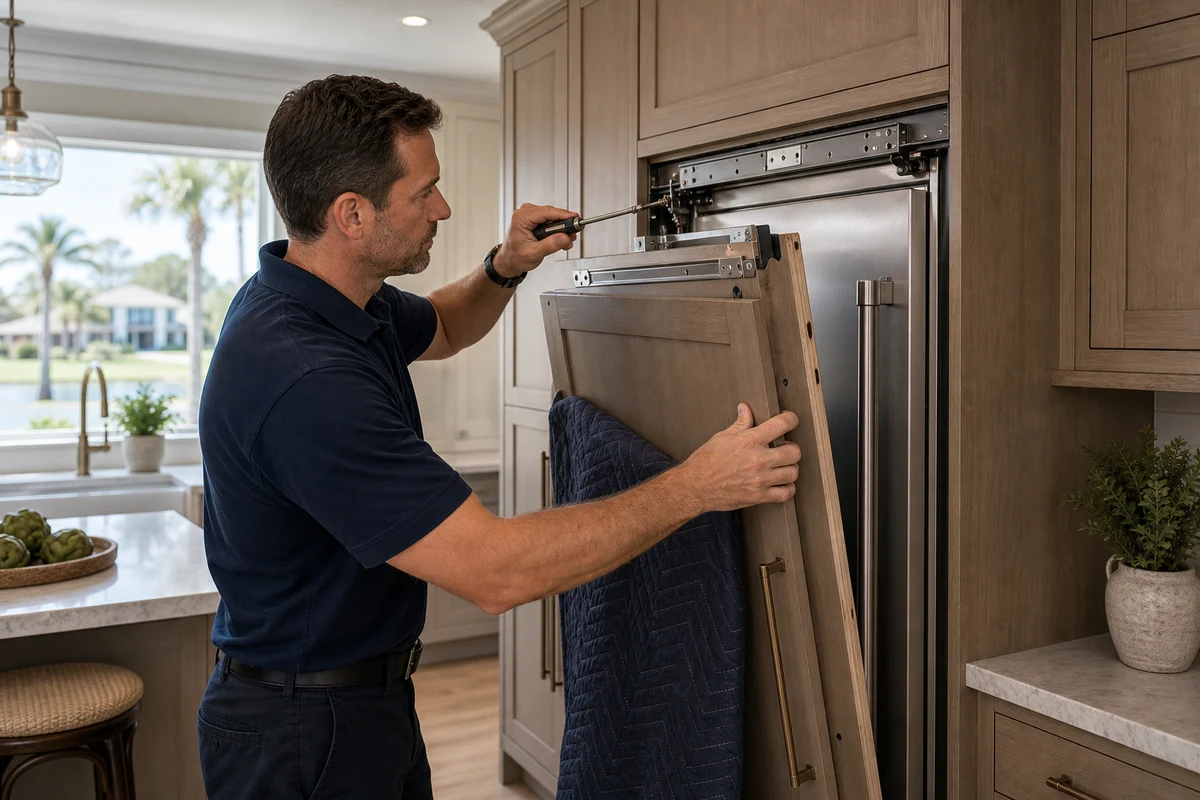
That flush install is the whole story. Two Sub-Zero® columns — one refrigerator, one freezer — flanking a custom panel is the signature look in mid-2010s Twenty Mile and Anthem Ridge customs, and it is gorgeous until something needs servicing. Then the panel has to come off, the part goes in, and the panel goes back with the hinge tension and alignment set exactly right. Get that wrong and the door sags; get it right and you cannot tell anyone was there.
We service every Designer family in Nocatee 32081 — call (904) 902-0927 or book through the online scheduling page, and tell us whether yours is a column, a tall combo, or a drawer unit so we arrive ready.
The Designer families we service in 32081
The letters tell you the shape, and the shape tells you the likely work. Here is the lineup behind most integrated Nocatee kitchens.
| Family | What it is | What it usually needs |
|---|---|---|
| IT-30CI / IT-36CI | Tall integrated combo, fridge over freezer | Ice maker fill, control board, filter |
| IC-24R / IC-30R / IC-36CI | Single-temperature flush columns | Panel and hinge work, evaporator fan |
| IC-24FI | Freezer column, often paired with a fridge | Defrost system, drawer seal, icing |
| ID-30 / ID-36 drawer units | Integrated undercounter refrigerator drawers | Drawer slides, gasket, thermistor |
Where integrated columns actually break
The refrigeration inside a Designer unit is recognizable Sub-Zero engineering, so the sealed system, fans, and boards fail the way they do across the line. What is distinctive is the cluster of integration-specific complaints — and the filter version errors that come from this generation reading its cartridge electronically.
| Symptom | First check on the visit | Usual cost lane |
|---|---|---|
| Door sags or won't sit flush | Hinge tension and panel mounting | $250–$550 |
| Filter or version error on display | Cartridge match and registration | $250–$550 |
| Integrated ice maker stopped | Fill valve, then module solenoid | $550–$1,100 |
| Column warm, fan silent | Evaporator fan motor draw | $250–$1,100 |
| Frost in a freezer column, food softening | Defrost heater and drain flow | $550–$1,100 |
An educational diagnostic scenario from Anthem Ridge
A composite case we use for owner education, not a customer review: an IC-30 freezer column in an Anthem Ridge custom kitchen builds frost and the door no longer seals clean. Pulling the panel reveals a hinge cartridge worn enough to let the door ride a few millimeters low, which broke the gasket seal and let humid Florida air in to freeze on the coil. New hinge cartridge, panel re-hung to spec, gasket reseated — the column holds 0°F and closes flush. The refrigeration was never the problem; the integration was.
How integration changes the visit
- Panel first, carefully. The custom door panel comes off with its hardware mapped, so it goes back exactly where it was.
- Evidence before parts. Temperatures, fan operation, board behavior, filter status, and — only when justified — sealed-system pressures.
- Written quote. One number that includes the integration labor, on paper, before anything is ordered.
- Repair, re-hang, verify. Part in, panel back on, hinge tension and alignment set, and the door checked for flush, square closure before we leave.
Because alignment drifts slowly, integrated columns reward the annual checkup more than any other unit in the house — catching a sagging panel or a tiring gasket before it becomes a frost-and-defrost repair. And since these kitchens often run two columns plus an undercounter, one scheduled window covers the set.
Diagnostic tells by Designer family
The IT, IC, and ID families production-dated through about 2022, and each shows its own characteristic tell. Reading the tell narrows the visit before a panel comes off.
| Family | Production window | The tell we look for |
|---|---|---|
| IT tall combos | to about 2022 | Ice fill faults and filter-version errors on the combined unit |
| IC refrigerator columns | to about 2022 | Door sag and panel bind before any refrigeration symptom |
| IC freezer columns | to about 2022 | Drawer or door frost from a defrost fault or a low-riding gasket |
| ID drawer units | roughly 2014–2020 (RP variants) | Slide wear and thermistor drift in tight undercounter cabinets |
A filter-version error is the most misread of these — owners assume a board fault when it's a cartridge mismatch the filter service clears in one stop.
Why integrated repairs lean toward keeping the unit
Replacing an integrated column is rarely a like-for-like swap. The cabinet was built around the unit's exact dimensions and the custom panel was made to match, so a new column that differs even slightly forces panel rework and sometimes cabinetry changes. That stacks cost on top of the appliance — which is why the repair-versus-replace math leans harder toward repair on a Designer unit than on almost anything else in the kitchen.
| What's wrong | Repair cost | Our honest call |
|---|---|---|
| Hinge cartridge, panel mount, gasket | $250–$550 | Repair — small money against custom-cabinet rework |
| Filter-version error, ice fill fault | $250–$1,100 | Repair — never a reason to replace a column |
| Evaporator fan, control board | $550–$1,100 | Repair — far under a column plus panel work |
| Sealed-system leak on an older column | $1,500–$3,000 | Weigh it — cabinet rework usually still tips to repair |
Why integrated columns reward maintenance most
Of every Sub-Zero in a Nocatee kitchen, the panel-ready column gains the most from a standing schedule — because its two signature failures, a sagging door and a frosting gasket, both build slowly and both get far cheaper when caught before the seal breaks.
| Wear item | Caught on the annual visit | If it's left until the seal breaks |
|---|---|---|
| Hinge cartridge loosening | Re-tensioned or replaced, door re-hung flush | Door rides low, gasket leaks, frost and defrost work follow |
| Door gasket hardening | Wipe-down now, gasket on your schedule | Humid air ices the coil; a defrost repair joins it |
| Panel mount drift | Bracket re-set, alignment corrected | Panel binds or rubs the adjacent cabinetry |
| Filter version overdue | Correct cartridge installed and registered | Version error masks the next real fault on the display |
Alignment drifts a few millimeters at a time, so it's invisible until the door stops sealing — exactly the kind of slow failure an annual once-over is built to catch. Because these kitchens usually run two columns plus an undercounter, one scheduled window covers the whole flush-installed set, and a worn hinge or a tiring gasket gets handled before it becomes the frost-and-defrost repair a broken seal eventually causes.
Designer column questions from Nocatee
What makes a Designer or integrated Sub-Zero different to service?
They install fully flush, hidden behind a custom cabinet panel rather than wearing stainless. That changes the work: the door panel and hinges must come off and go back on in perfect alignment, or the door binds, sags, or seals poorly. The refrigeration is familiar Sub-Zero engineering — the install integration is what adds time and skill.
My IC column shows a filter version or filter error — what is that?
Designer-generation units read the filter cartridge electronically and reject the wrong version with a fault on the display. It is almost always a filter mismatch, not a board problem — someone fitted a near-match cartridge or skipped registration. We carry the correct versions, install and register the right one, and the error clears.
Do I need to send my cabinet maker out after a column repair?
No — handling the panel is our job, not theirs. We remove and remount the custom panel and re-set the hinge tension and door alignment so it closes flush the way it did before. If a panel mounting bracket or a hinge cartridge is worn, we replace it. You should not be able to tell, from the outside, that the column was ever touched.
Are these IT and IC columns still under factory warranty?
It depends on the install date. Designer tall and column production ran to about 2022, so older installs in Twenty Mile and Anthem Ridge are typically out of coverage and squarely our lane. Newer ones may still be covered. We check the serial before quoting, and if the factory should pay, we point you there — see our warranty guide for the line.
Can a single column be repaired without disturbing its paired unit?
Yes. Designer kitchens often run a refrigerator column next to a separate freezer column, each a self-contained unit. We service the one that is misbehaving without pulling its neighbor, which keeps the working column cold and your food where it is. If both share a custom surround, we protect the second panel while we work.
How can I tell an integrated Sub-Zero column from a Classic Built-In?
Look at the face. A Classic Built-In wears a stainless or glass door and sits flush to the cabinet; a Designer integrated column is hidden behind the same wood or painted panel as your cabinetry, so it disappears into the run. If you can't spot the fridge without opening a door, it's integrated — and the model number on the rating plate will start with IT, IC, or ID.
My integrated column door has started to sag — is that the hinge or the panel?
Almost always the hinge cartridge, with the heavy custom panel speeding the wear. The panel adds weight the hinge carries every time the door swings, so over years the cartridge loosens and the door rides a few millimeters low — enough to break the gasket seal and let humid air in. We replace the hinge cartridge and re-hang the panel to spec so it closes flush again.
How heavy is a custom panel on a Sub-Zero column, and why does that matter for the repair?
A full-height wood or painted panel on a 30- or 36-inch column can run well over fifty pounds, and that weight is the reason integrated columns wear hinges and gaskets faster than a stainless BI door. It also means panel removal is a two-handed, mapped job — we photograph and label the hardware before it comes off so it returns to the exact same position and the door closes flush. Rushing that step is how a DIY repair leaves a door that binds.
Why does my IT tall combo throw an ice fault when the BI next to it never did?
The IT combines a fridge and freezer in one tall integrated cabinet with an ice maker fed through the same hard-water path as everything else in 32081, but its fill and harvest sit in a tighter integrated layout. On 14–28 grain water the fill valve scales the same way a BI's does, yet the IT's combined design means an ice fault can also trace to the shared control or the filter version. We check the cartridge match first, then the valve and module.
Ready when your Sub-Zero isn't
Weekdays 8 to 7, Saturdays 9 to 3. Gate access handled, floors protected.