Maintenance · One visit, five systems
The Annual Sub-Zero Checkup for Nocatee Homes
Sub-Zeros almost never fail without warning — they fail without anyone looking. This is the looking.
Sub-Zero Service Nocatee runs annual maintenance visits across 32081 from $250: condenser cleaned, gaskets and defrost inspected, the water path checked against 14–28 grain local water, and temperatures verified at 38°F and 0°F. One scheduled hour a year is what keeps most Nocatee units off our emergency call sheet.
For independent Sub-Zero repair across Nocatee and the 32081 master plan, call (904) 902-0927 for a same-week written quote or Book online.
What one scheduled hour a year buys
A Sub-Zero® is engineered for a twenty-year-plus service life, but the engineering assumes somebody occasionally clears the coil, checks the seals, and notices drift before it becomes failure. In a community where the oldest kitchens date to Coastal Oaks' 2006 ground-breaking, "somebody" increasingly needs to be deliberate — those original units are now in the years where small neglect compounds fastest.
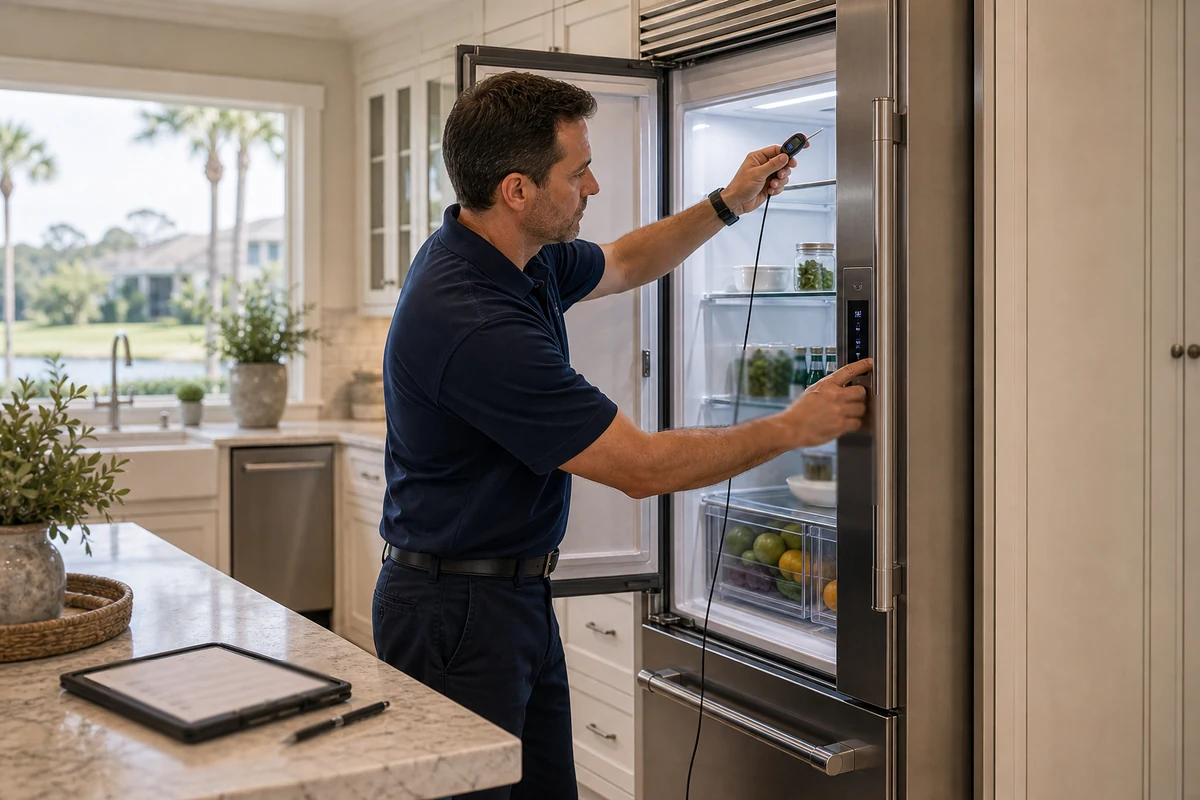
The checkup is built around the five systems that actually generate our repair calendar. Nothing exotic: dust, rubber, ice, scale, and temperature. Each one is cheap to inspect and expensive to ignore, which is the whole logic of the visit. What we find goes in a short written report, priced honestly — including the finding "nothing, see you next year."
| We check | Looking for | The failure it heads off |
|---|---|---|
| Condenser coil and fan | Dust load, fan draw, run-time history | EC 50 codes, compressor burnout |
| Door gaskets | Hardening and tears from year-round humidity | Frost buildup, marathon run times |
| Defrost system and drain | Heater and thermostat function, drain flow | Iced evaporators, floor ice slabs |
| Water path and filter | Scale at the valve and filter head | Starved ice makers, dead fill valves |
| Set points and pull-down | Verified 38°F / 0°F performance | Quiet drift that spoils food first |
Why we time checkups to beat storm season
Northeast Florida's summer pattern — 100-plus thunderstorm days, outages, and the voltage spikes that ride power restoration — is the hardest thing this region does to a refrigerator. A unit that enters June with a loaded coil and leaking gaskets is already running at its limit when the grid starts misbehaving. We book most annual visits in spring for exactly that reason, and we'll flag surge protection if your panel lacks it; a whole-home unit installed by an electrician runs around $900–$1,200 and is cheaper than one storm-killed control board repair.
Checkups are also where warranty honesty pays off. If your kitchen runs a 2022-or-newer unit, repairs belong with the factory — but maintenance is the owner's responsibility regardless, which is why CL-generation owners book this visit too. For everything older, from Coastal Oaks-era BI units to panel-ready Designer columns, the checkup is the difference between scheduled service and a spoiled-food emergency.
Your between-visit checklist
The annual visit is the deep work; these are the small things worth doing yourself across the year so the unit reaches your appointment in good shape.
| How often | Do this | Why it matters here |
|---|---|---|
| Monthly | Glance at the display; note any error code or beep | An early EC 50 is a cleaning, not a compressor |
| Every 2–3 months | Vacuum the upper condenser grille | Construction dust and pollen mat the fins fast |
| Every 2–3 months | Wipe the door gaskets clean and check the close | Grime and humidity harden seals and break the magnet line |
| Every 6–9 months | Change the water filter on the 32081 interval | 14–28 grain water spends a cartridge early |
| After any outage | Confirm the panel responds and temps recover | A restoration surge can lock a BI control board |
A worked example: one kitchen, three units
Take a typical Twenty Mile custom: a paired Designer refrigerator and freezer column, plus a wine unit in the butler's pantry. Booked as three separate emergency calls over a year, that's three trip charges, three diagnostic windows, and three gate clearances. Booked as one annual checkup, the truck arrives once, the per-unit rate steps down after the first, and every unit gets the same five-system inspection in a single scheduled window.
The arithmetic favors the bundle, but the real saving is the failures it heads off: a wine column's drifting thermistor caught at inspection is a sensor swap, not a ruined case of Bordeaux. That is the logic behind keeping a multi-unit household on a single coil-and-checkup rhythm rather than waiting for each unit to announce itself.
What's in the written report you keep
A checkup that leaves nothing behind is just a visit. Ours ends with a short written report, and the value is in what it records: the actual fresh-food and freezer temperatures we measured against the 38°F / 0°F target, the condition of each wear system, and an honest forecast of what is likely to need attention before next year — with the cost lane attached so nothing is a surprise later.
- Measured temperatures. The real numbers, not "seems cold" — fresh food and freezer, after the unit has stabilized.
- System-by-system condition. Coil, gaskets, defrost and drain, water path and filter, each marked healthy, watch, or service-now.
- Filter and interval set. The cartridge installed or assessed, and the replacement date keyed to 14–28 grain water rather than the box.
- Next-year forecast. The one or two parts most likely to age out, with the lane they fall in, so a future repair is a budgeted decision and not an emergency.
For a fifteen-year Coastal Oaks BI unit, that forecast is the difference between planning a board or gasket on your schedule and discovering it on a holiday weekend.
The economics of catching it early
The checkup earns its fee by converting expensive emergencies into cheap, scheduled fixes. Each of the five systems has a "caught early" cost and an "ignored" cost, and the gap is the whole case for the visit.
| The wear item | Caught early at the checkup | Discovered as a failure |
|---|---|---|
| Dust-loaded condenser | $250–$550 cleaning | $1,000–$2,000 cooked compressor |
| Hardening door gasket | Wipe-down now, gasket on your schedule | $550–$1,100 plus frost and spoiled food |
| Drifting defrost thermostat | Flagged before it ices the coil | $550–$1,100 defrost repair, warm freezer |
| Scale at the fill valve | $250–$550 descale and filter | $550–$1,100 scored-valve replacement |
| Quiet temperature drift | Corrected before food is at risk | A cooler full of spoiled groceries |
The pattern is consistent across every row: the maintained version sits in the $250–$550 lane, the failed version costs two to four times more and arrives without warning. On a fifteen-year Coastal Oaks BI unit, that gap is the difference between a budgeted spring visit and a holiday-weekend scramble. The coil cleaning alone closes the top row.
Maintenance questions, answered plainly
What exactly is included in the annual Sub-Zero checkup?
Five systems, one visit: condenser cleaned and fan checked, door gaskets inspected and light-tested, defrost system and drain verified, the water path checked for scale with the filter assessed, and compartment temperatures confirmed at 38°F and 0°F. You get a short written report — what's healthy, what's wearing, what it would cost if it fails.
When in the year should Nocatee owners schedule maintenance?
Spring, ideally before June. Storm season stacks outages and restoration surges on top of summer heat — the two hardest things this climate does to refrigeration — so going into it with a clean coil, sound gaskets, and verified temps matters. April and May appointments also book easier than post-storm weeks ever do.
Is an annual checkup genuinely worth it, or is it a maintenance upsell?
Fair question to ask any shop. The math: a checkup sits in the $250–$550 lane, while the failures it's designed to intercept — cooked compressors, iced evaporators, scale-killed valves — run $550 to $2,000 or more. It will not catch everything; nothing does. It reliably catches the expensive, slow-building ones.
Can you cover two or three units in a single maintenance visit?
Yes, and most of our larger Twenty Mile and Coastal Oaks households do exactly that — a column pair, wine storage, and an undercounter ice machine in one scheduled window. Per-unit pricing steps down after the first because the truck is already there. Tell us the lineup when you book and we'll quote the set.
Does a maintenance history help if I sell my Nocatee home?
It does — a documented service record on a fifteen-year-old Coastal Oaks Sub-Zero answers the buyer's inspection question before it's asked. A built-in that shows verified 38°F / 0°F temps, a clean coil, and current filters reads as cared-for rather than as a five-figure unknown. We leave a written report after every checkup precisely so you have that paper trail.
What can I do between annual visits to keep my Sub-Zero healthy?
Three small habits cover most of it: vacuum the upper condenser grille every few months, wipe the door gaskets so grime doesn't harden the seal, and change the water filter on the interval we set for 32081 water rather than the box. Note any error code or post-outage hiccup when it happens — that history sharpens the next diagnosis.
How is an annual checkup different from just booking a coil cleaning?
A coil cleaning is one system; the checkup is five. The cleaning clears the condenser and verifies the fan and temperatures — genuinely the single highest-value item. The checkup adds the gasket light-test, the defrost and drain verification, and the water-path scale check, then leaves a written report on each. If you only do one thing a year, do the coil; if you want the slow, expensive failures intercepted, do the checkup.
Is an annual checkup worth it on a newer Twenty Mile unit that rarely has problems?
Yes, for two reasons specific to a young unit. Maintenance is the owner's responsibility no matter how new the Sub-Zero is, and a documented service record protects resale value on a fast-turning Nocatee street. The checkup also catches the early wear — a gasket starting to harden, a filter spent on hard water — while it's still a wipe-down or a cartridge, long before it becomes a defrost or valve repair.
Ready when your Sub-Zero isn't
Weekdays 8 to 7, Saturdays 9 to 3. Gate access handled, floors protected.