Repair · Nocatee & Ponte Vedra 32081
Sub-Zero Refrigerator Repair in Nocatee
A built-in that's drifting warm is solvable — the trick is finding the real cause before anyone names a part.
Sub-Zero Service Nocatee diagnoses and repairs out-of-warranty Sub-Zero refrigerators across the 32081 master plan, from Coastal Oaks to Seabrook Village. Most refrigerator calls land between $250 and $1,100; sealed-system work runs $1,500–$3,000, always quoted in writing first. Units still under factory coverage get routed to factory service instead.
For independent Sub-Zero repair across Nocatee and the 32081 master plan, call (904) 902-0927 for a same-week written quote or Book online.
Page reviewed against our service log: June 13, 2026.
What a warm Sub-Zero is usually telling you
Sub-Zero® refrigerators are built to hold 38°F on the fresh-food side for twenty years or more, so when one drifts, something specific has changed. In our Nocatee call sheet, four causes cover nearly every warm refrigerator: a dust-choked condenser, a failed evaporator fan, a control board fault, and — least often but most expensive — a sealed-system refrigerant leak.
The order matters. A blocked condenser mimics a dying compressor, and a fan that quit mimics a refrigerant leak, which is why we never quote sealed-system money until airflow and electrical checks have cleared. If your freezer still freezes while the fridge runs warm, start with the step-by-step warm-fridge checklist before booking — it rules out the two causes that don't need a technician at all.
We service Sub-Zero refrigeration throughout Nocatee 32081 — call (904) 902-0927 or use the online booking page and we'll confirm your model and warranty status before the truck moves.
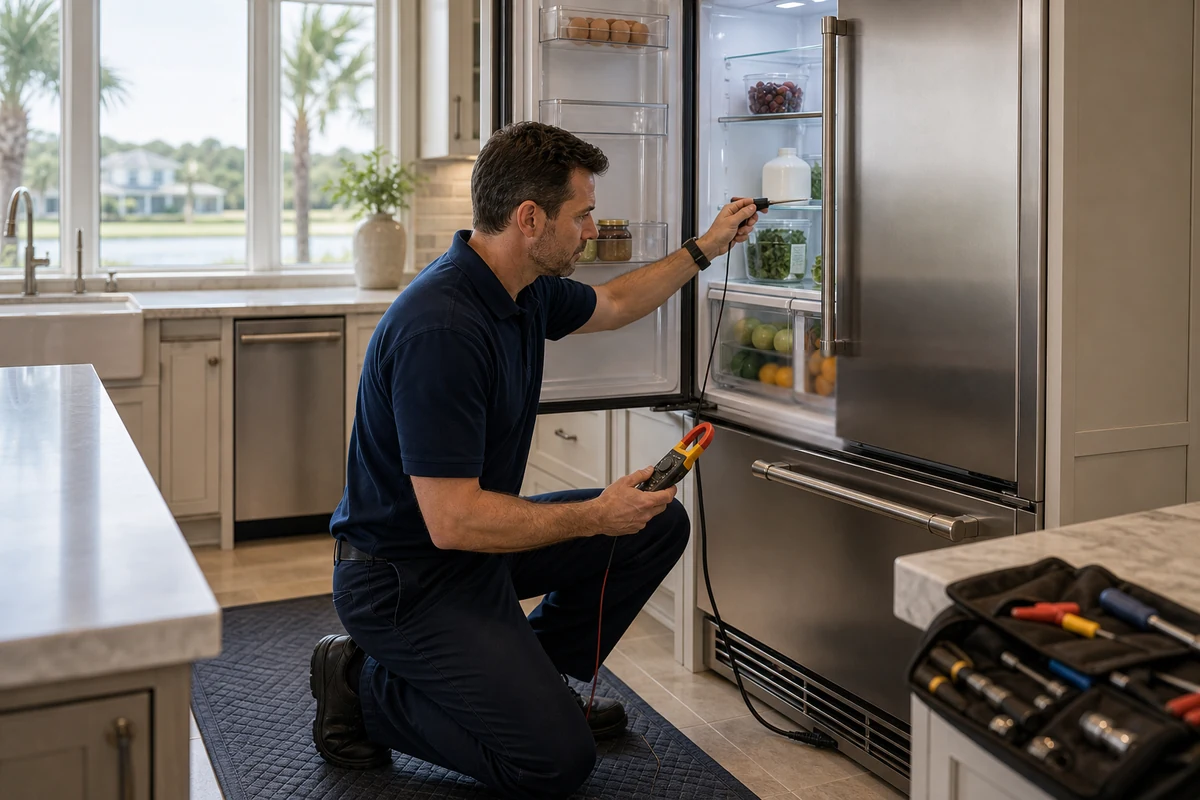
Symptom, first check, and the money it points to
These are the refrigerator-side patterns we see most in 32081, with the first thing we test and the cost lane each one usually lands in.
| Symptom | First check on the visit | Usual cost lane |
|---|---|---|
| Fridge warm, freezer fine, unit runs nonstop | Condenser dust load, then evaporator fan | $250–$550 |
| Both sides warming, compressor hot to the touch | Condenser airflow and fan-motor draw | $250–$1,100 |
| Lights on, control panel blank after an outage | Board power-up test before any part talk | $550–$1,100 |
| Temperatures swing, food freezes then thaws | Thermistor readings against spec | $550–$1,100 |
| Slow warm-up over weeks, partial frost on evaporator | Pressure evidence for a sealed-system leak | $1,500–$3,000 |
Why storm season fills our refrigerator schedule
Northeast Florida leads the country in cloud-to-ground lightning, and every June-to-October outage cycle sends a wave of refrigerator calls through Nocatee. The damage rarely happens when power drops — it happens when it comes back, riding a restoration spike that can run well above nominal voltage. Built-in control boards, especially on the 2008–2022 BI generation, are the usual casualty: lights work, the panel stays dark, cooling stops.
Two honest notes from the field. First, a whole-home surge protector — roughly $900–$1,200 installed by an electrician — is cheaper than one board replacement and protects everything else in the house. Second, if your unit went dark after an outage, check for an EC 50 code on the display before assuming the worst; long compressor run after a hot, door-open afternoon is a different and much cheaper problem.
An educational diagnostic scenario from Anthem Ridge
A composite case we use for owner education, not a customer review: a 2014 BI-36UFD in Anthem Ridge reads 52°F on the fridge side the morning after a July storm. Interior lights work; the panel is unresponsive. Airflow checks clean, the compressor never receives a run signal, and board voltage tests confirm a brownout-locked control. One board, one afternoon, and the unit is holding 38°F again — no compressor, no sealed system, no five-figure replacement conversation.
Nocatee's build waves, and what each one breaks
Nocatee went vertical in waves, and each wave installed a different Sub-Zero generation — which means your street roughly predicts your failure mode. Coastal Oaks broke ground in 2006, so its originals are late 600-series and first-run BI units now fifteen-plus years old: prime territory for boards, ice makers, and door gaskets hardened by Florida humidity. Mid-2010s customs in Twenty Mile and Anthem Ridge lean toward panel-ready Designer columns, where access and hinge work shape the repair. The newest builds carry CL-generation units that are still the factory's responsibility — our plain-English warranty guide explains exactly where that line sits.
Freezer-side trouble on the same unit is its own discipline — frost sheets and defrost faults behave differently than warm-fridge calls, and we cover them on the freezer repair page.
How a refrigerator visit actually runs
- Serial check first. We confirm model and warranty status on the phone — if the factory should pay for your repair, we say so and step aside.
- Evidence before parts. Temperatures, airflow, fan operation, board behavior, and — only when justified — refrigerant pressures.
- Written quote. One number, on paper, before anything is ordered or opened. Approve it and the diagnostic folds in.
- Repair and verify. We set 38°F / 0°F, confirm pull-down, and flag anything that will need attention within the year.
One scheduling note for gated streets: we keep gate procedures for Coastal Oaks on file, so approval delays don't eat your appointment window.
The refrigerator-side parts we replace most, and why
A short list of components accounts for the large majority of warm-fridge repairs in 32081. Knowing the part — and what kills it here — is most of the diagnosis.
| Part | What it fixes | Why it fails in Nocatee | Lane |
|---|---|---|---|
| Evaporator fan motor | Fresh food warm, freezer fine | Bearing wear after years of continuous run; no airflow, no cold | $250–$550 |
| Control board (BI generation) | Lights on, panel blank, cooling stopped | Restoration surge after a storm-season outage locks the board's logic | $550–$1,100 |
| Thermistor (temperature sensor) | Temps swing, food freezes then thaws | Sensor drift sends the board a wrong reading; cheap part, big symptom | $550–$1,100 |
| Door gasket | Marathon run times, frost at the door line | Year-round humidity hardens the magnetic seal faster than the spec sheet expects | $550–$1,100 |
| Condenser fan / cleaned coil | Both sides warming, compressor hot, long run | Construction dust and kitchen film mat the upper coil; heat can't escape | $250–$550 |
Note the price floor: three of the five live in the $250–$550 lane, which is why a diagnosis-first visit so often ends cheaper than owners fear. The coil cleaning service alone closes the bottom row before a part is even quoted.
When to call, and the two things worth trying first
A built-in refrigerator is not a DIY appliance — the sealed system, the board, and the flush cabinet put most repairs out of an owner's reach. But two checks are genuinely yours, and they save a service call often enough to be worth five minutes.
| Situation | Try first yourself | Call when |
|---|---|---|
| Whole unit dark, no lights | Check the breaker and the outlet behind the kickplate | Power is confirmed but the unit stays dead |
| Both sides drifting warm, long run | Vacuum the upper condenser grille; give it 24 hours | It's still warm after a clean coil and a full day |
| Lights on, panel blank after an outage | Nothing safe — this is board territory | Right away; forcing power cycles can worsen it |
| Partial frost on the evaporator, slow warm-up | Nothing — this is sealed-system diagnosis | Before you assume a leak; cheaper causes mimic it |
The line is simple: anything that needs a meter, refrigerant gauges, or a panel pulled is ours, because guessing on a $7,000 built-in is the expensive way to learn. Anything that's a breaker, an outlet, or a dusty grille is worth a look before you book. When the symptom survives both checks, the not-cooling walkthrough narrows it further before a truck rolls.
Telling two look-alike causes apart
Half the warm-fridge calls in Nocatee come down to two pairs of causes that feel identical from the kitchen but cost very different money. Here is how the symptoms diverge once you know what to watch.
| The pair | Points to the cheaper cause | Points to the costlier cause |
|---|---|---|
| Dirty coil vs. failing compressor | Visibly matted grille; cools after a clean and 24 hours | Clean coil, compressor hot, still warm next day |
| Evaporator fan vs. refrigerant leak | Warms in hours, cabinet silent, no air moving | Warms over days, partial frost on the evaporator |
| Brownout-locked board vs. dead compressor | Lights on, panel blank, follows a storm outage | Panel responds, compressor silent or hard-clicking |
| Tired gasket vs. defrost fault | Frost rings the door line, dollar-bill slides free | Frost sheets the back wall, defrost circuit tests open |
The freezer side is the single most useful clue: when it still freezes hard, the sealed system is almost always intact, which rules the most expensive causes out before a truck rolls. Work the five-check not-cooling walkthrough first, and if a code is showing, read what EC 50 is telling you so you arrive at the call already half-diagnosed.
Refrigerator repair questions from 32081 owners
How fast can you get to a warm refrigerator in Nocatee?
Usually within the same week, often within a day or two — we run 32081 daily, so Coastal Oaks, Twenty Mile, and Seabrook Village are on the regular route. Tell us how warm the compartment is when you call; a fridge climbing past 45°F gets bumped up the schedule.
Do you charge a diagnostic fee if I approve the repair?
The diagnostic visit is a real cost, so yes, it exists — but it folds into the repair when you approve the written quote. You never pay to be diagnosed and then pay full freight on top. If the smart move is no repair at all, you only owe the visit.
Are parts still available for the units in Nocatee's first homes?
Almost always. The earliest Coastal Oaks kitchens hold late 600-series or early BI units, and gaskets, fan motors, thermistors, and ice maker parts remain in supply. A few 600-series control boards have gone scarce and are rebuilt rather than replaced — we tell you which situation you're in before quoting.
Could this summer's storms have damaged my refrigerator's control board?
It's one of the first things we check from June through October. Northeast Florida sees 100-plus thunderstorm days a year, and the voltage spike when power is restored after an outage — not the outage itself — is what locks up or kills boards. Lights on but a blank, unresponsive panel is the classic signature.
Should I unplug a Sub-Zero that's running warm?
No — leave it running and move the most perishable food to a cooler or second unit. A struggling compressor still does some work, and the temperature history helps diagnosis. The exception is a unit tripping its breaker repeatedly; let it stay off and call, because forcing restarts can finish off a failing component.
How long should a refrigerator-only call take, and will it be done in one trip?
Coil cleanings, fan-motor swaps, and thermistor replacements are almost always one-trip jobs — the parts ride on the van. Control boards and sealed-system work are the exceptions, because the board revision is matched to your serial and refrigerant work is scheduled separately. We tell you which category yours is during the diagnosis, before you commit.
My Sub-Zero runs but the digits on the display look frozen — board or sensor?
Double dashes or a panel that won't respond to button presses point at the control board, not a sensor. A thermistor reading wrong shows up as wrong temperatures, not a frozen display. We confirm with a board power-up test before naming the part; on a Nocatee BI unit, a post-outage surge is the usual reason a board's logic locks up.
How do I tell a failed evaporator fan from a refrigerant leak without opening anything?
Two tells separate them. A dead evaporator fan goes warm fast — often within hours — and the cabinet is silent where you'd normally hear air moving, while the freezer side may still hold. A sealed-system leak warms slowly over days or weeks and frosts only part of the evaporator. The fan is a $250–$550 fix; the leak is sealed-system money, so the distinction is worth getting right before anyone quotes.
Does a Sub-Zero column refrigerator break differently than a BI-36U over-under?
The systems overlap, but two things shift. A single-temperature refrigerator column has no freezer-side defrost or ice maker of its own, so its failures concentrate on the evaporator fan, thermistor, and board. And if it's a panel-ready Designer column, hinge and panel work joins almost every repair. We cover that integration work in detail on the Designer column service page.
Ready when your Sub-Zero isn't
Weekdays 8 to 7, Saturdays 9 to 3. Gate access handled, floors protected.